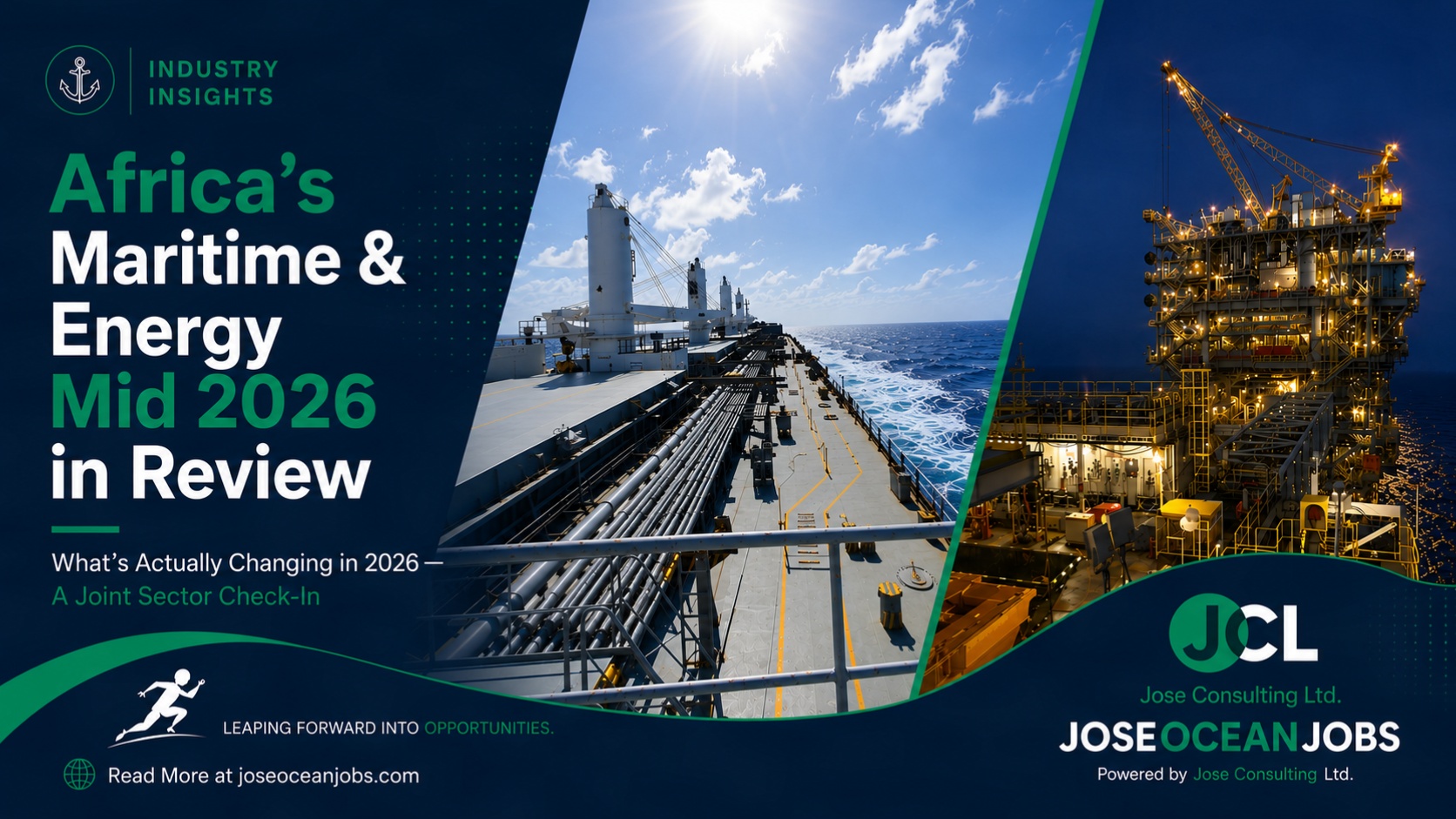
Maritime & Energy Mid-2026 Check-In: What's Actually Changing for African Professionals
🚀 Leaping forward into opportunities
We're halfway through 2026, and both the maritime and energy sectors are moving fast. Regulatory deadlines, fuel transitions, LNG demand growth, and offshore hiring momentum are converging at once — opening doors for African talent that didn't exist eighteen months ago. Here's what's real, and how to position yourself for the second half of the year.
⚓ Maritime Mid-Year Review
The big story in shipping this year isn't a breakthrough — it's a recalibration. The IMO's proposed Net-Zero Framework was delayed by a year at the end of 2025, and owners are now focused on compliance over transformation.
Executives rank LNG as the most viable transition fuel over ammonia or methanol, since bunkering infrastructure already exists — making it the industry's known quantity. LNG bunkering ports are projected to pass 250 globally this year.
Compliance skills are in demand. The EU's FuelEU Maritime regulation requires its first verified emissions report by end of January 2026, driving demand for professionals fluent in monitoring, reporting, and verification (MRV).
Digitalisation is now a compliance tool. Predictive emissions tracking and vessel digital twins are becoming standard, making digital literacy essential for operations roles.
The crewing gap is widening. Seafarer shortages are at multi-year highs and trained-crew availability is now a top risk category for shipping executives — a clear tailwind for African seafarers.
🛢️ Energy Mid-Year Review
African energy is a story of acceleration; genuinely one of the most active hiring markets the continent has seen in years.
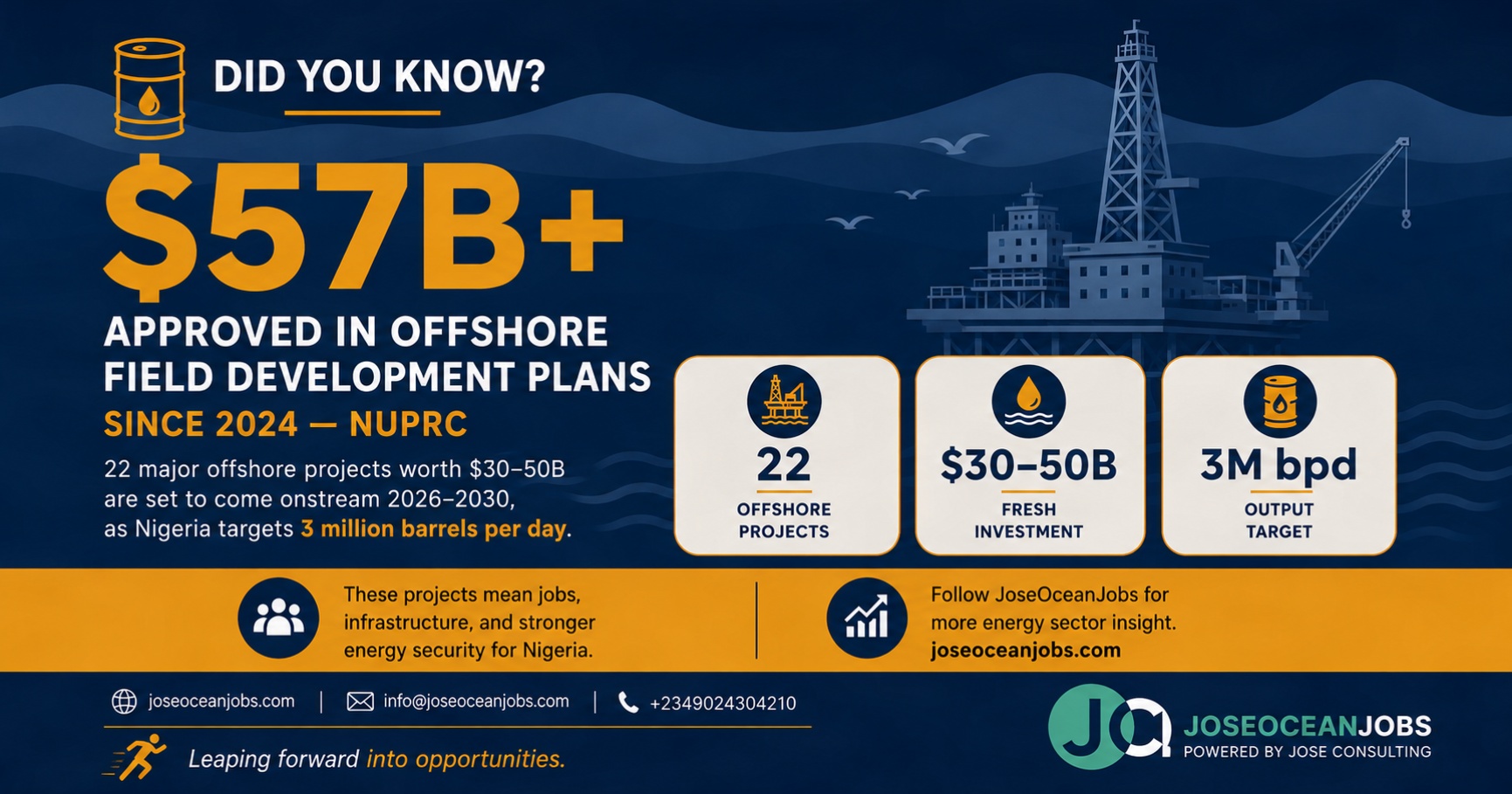
Investment is surging. Upstream oil and gas investment is forecast at $41 billion in 2026, with offshore spend alone hitting $19 billion, led by deepwater work in Namibia and Tanzania.
African LNG is a global priority. With Europe phasing out Russian gas, Mozambique LNG restarted in January 2026 after a four-and-a-half-year pause, and Tanzania's Shell/Equinor terminal is targeting a 2026 final investment decision.
Nigeria remains a heavyweight, with 1.63 million barrels/day produced in 2025 (+5% YoY) and a $10 billion Train 7 LNG expansion underway.
Renewables are scaling, anchored by Egypt's Benban Solar Park and South Africa's REIPPP programme.
Uganda's Lake Albert projects are nearing first oil, with Tilenga and Kingfisher roughly 70% complete and output moving via EACOP.
Where the Two Sectors Overlap
Maritime and energy increasingly draw on the same talent pool:
- LNG shipping sits at the intersection — African LNG growth drives demand for carrier crew, terminal staff, and marine logistics coordinators.
- Offshore energy depends on maritime support — FPSOs and offshore vessels across Angola, Ghana, and Mozambique need the same marine specialists and ROV pilots shipping companies compete for.
- HSE and compliance skills transfer directly between emissions reporting on a vessel and safety protocols on a platform.
- Digital and data skills are now baseline in both sectors, from digital twins to grid integration.
- Cross-training across both fundamentals gives African professionals a real edge, you're building skills both industries are actively bidding for.
Certifications Gaining Relevance in the Second Half of 2026
- BOSIET / HUET — increasingly baseline for offshore roles
- NEBOSH — non-negotiable for HSE and operations roles
- GWO Basic Safety Training — relevant as renewables hiring accelerates
- STCW updates — a direct advantage amid crew shortages
- MRV / emissions reporting familiarity — a growing differentiator for shore-based roles
- PMP or equivalent — needed for major LNG and pipeline project delivery
How JoseOceanJobs Supports Both Tracks
This is exactly why JoseOceanJobs exists — to help African professionals navigate maritime and energy careers without piecing together fragmented information. Through our Starter, Intermediate, LEADS, and Pre-Departure Training programmes, we prepare candidates from foundational certifications through to leadership-level readiness for international deployment and connect you with opportunities shaped by what's happening in the industry today.
Register on joseoceanjobs.com today to explore training programmes and connect with active opportunities.
Train. Connect. Succeed.
Written by
JCL Editorial
Editorial team covering maritime hiring trends, offshore workforce policy, and certification updates relevant to JOSEOCEANJOBS candidates and employers.