When a country puts a number into its innovation readiness, the number matters less than what comes next. In October 2026, the Nigerian Institution of Marine Engineers and Naval Architects (NIMENA) did exactly that for Nigeria's maritime and energy sectors, and the roadmap that came with it has real implications for anyone building a career in either industry.
What was released
NIMENA launched the Maritime and Energy Ecosystem Capability Model (ECM), an assessment developed with Plug and Play, the global innovation platform. The two organisations announced their partnership in Singapore in April 2026, and the ECM is the first major output of that work.
The assessment looks at five dimensions: Capital (access to finance), Network (collaboration and international market connections), Society (talent, skills and entrepreneurial culture), Initiatives (innovation infrastructure and commercialisation programmes) and Regulations (the legal and institutional conditions that help businesses grow). It draws on desk research, stakeholder interviews and international benchmarking against Kenya, Egypt, South Africa and Singapore.
The score, and why “Emerging” is a starting point
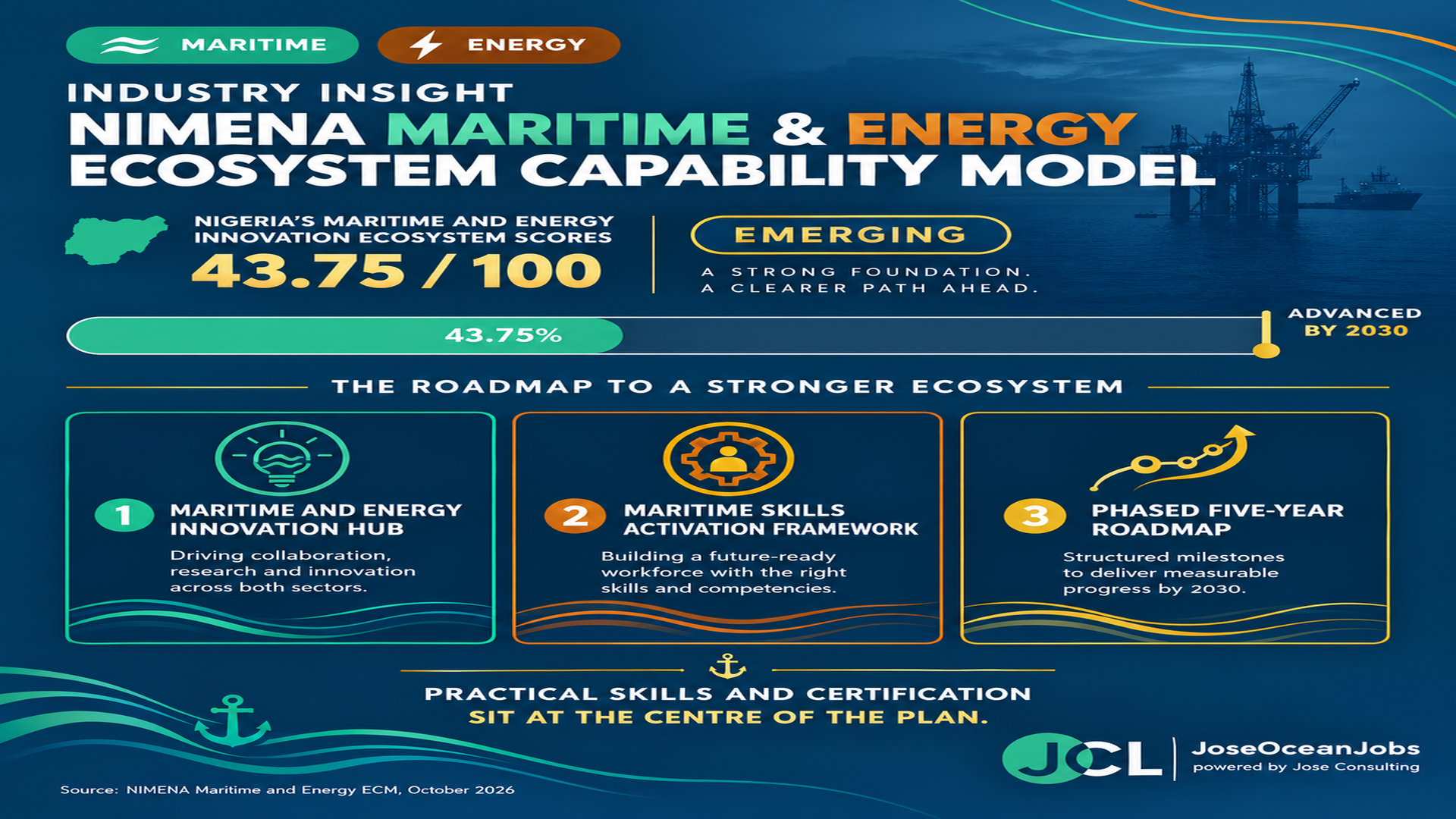
Nigeria's maritime and energy innovation ecosystem scored 43.75 out of 100 and was placed in the “Emerging” category. Regulations came out as the strongest dimension. Network and Society scored lowest, which points directly at two things: stronger connections between institutions, and better development and retention of specialised talent.
An Emerging rating is a stage, not a verdict. The report sets a clear target of reaching the “Advanced” category by 2030, and it lays out how.
The roadmap in brief
The growth plan proposes a Maritime and Energy Innovation Hub to connect promising technologies with corporate challenges, pilot opportunities, investors and international partners. It is backed by a phased five-year roadmap that would grow the hub from an initial launch into a sustained national institution.
Priority recommendations include dedicated funding for maritime and energy startups, stronger investor engagement, clearer regulatory pathways, supervised testing environments, and a Maritime Skills Activation Framework that links education and certification to industry requirements and employment outcomes.
Progress would be measured by tangible results: startups securing commercial contracts, greater investment in maritime ventures, stronger graduate participation in technology enterprises, and improved collaboration between public and private institutions.
NIMENA's National Chairman, Engr. Dr. Eferebo I. Sylvanus, called on institutions to “move past fragmentation” and unite behind one structured framework. The report is being sent to the Federal Ministry of Marine and Blue Economy, NIMASA, NCDMB, COREN, the Nigerian Society of Engineers, the Federal Ministry of Innovation, Science and Technology and the National Assembly as a policy advisory document.
Three priorities the report identifies
The report groups its findings into three interlocking priorities:
- Turning a youthful population into industry ready capability. Nigeria's demographic strength becomes an advantage when training connects directly to what employers need.
- Aligning corporate demand with the technical readiness of local ventures. Companies and indigenous technology firms need clearer pathways to work together on real projects.
- Consistent implementation of promising policies and funding mechanisms. Good policy delivers its full value when it is applied steadily.
Capabilities to watch
The assessment highlights remote condition monitoring, digital twins and virtual asset management as areas where local participation in maritime and energy value chains can grow. These are skills built on solid technical foundations: engineering knowledge, safety competence and recognised certification.
What this means for aspiring seafarers and energy professionals
Read as a career signal, the report is encouraging. The Maritime Skills Activation Framework puts the link between education, certification and employment at the centre of national planning. That means practical, verifiable skills are where these sectors are heading.
For cadets and early career professionals, the practical takeaways are straightforward:
- Build a strong technical foundation, because digital tools such as condition monitoring and digital twins still rest on core engineering and seamanship knowledge.
- Pursue recognised certification early. Credentials such as STCW, BOSIET and NEBOSH are the kind of industry requirements a skills framework would connect to employment outcomes.
- Stay curious about technology. Familiarity with digital monitoring and asset management will increasingly complement traditional skills.
The bigger picture
Nigeria's maritime and energy sectors are already seeing significant activity, from offshore investment to growing port traffic. The ECM adds a missing piece: a shared, data driven framework for developing the people and technologies that sustain that growth. The score today is 43.75. The goal is Advanced by 2030. The skills pathway is already clear.
Follow JoseOceanJobs for more insights on building a career in Nigeria's maritime and energy sectors.
🚀 Leaping forward into opportunities. Train. Connect. Succeed.
Written by
JCL Editorial
Editorial team covering maritime hiring trends, offshore workforce policy, and certification updates relevant to JOSEOCEANJOBS candidates and employers.